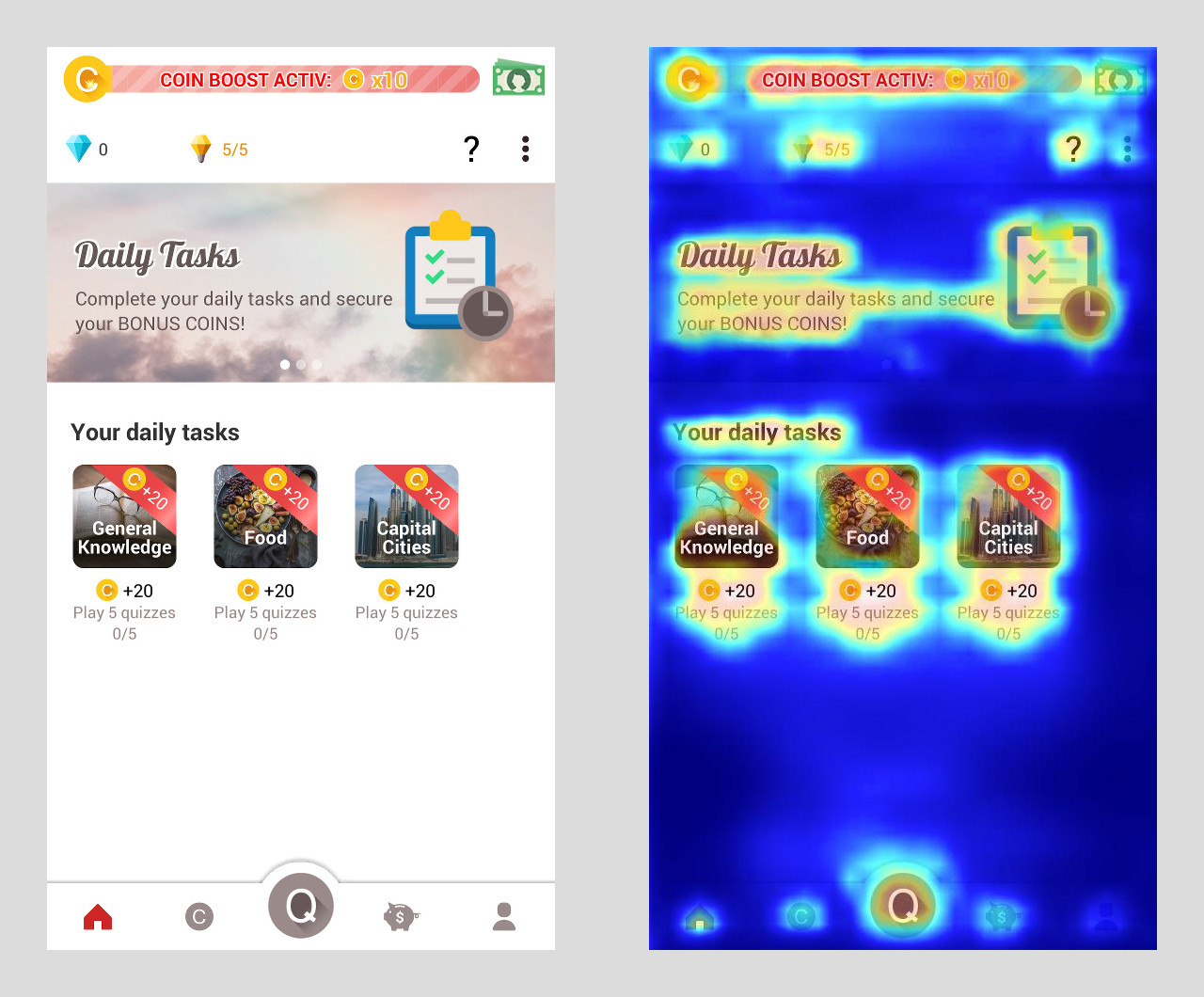
Experimenting with ML-driven design analysis using visual importance networks trained on eye-tracking data to predict where users focus attention in UI designs.
Visual importance is a machine learning approach trained on real eye-tracking heatmaps from UI studies. The network predicts which areas of a design naturally draw user attention - red areas show high interest, blue shows low interest.
I applied the model to Instagram’s Oscar feed and analyzed designs from our Quiz Friends app to validate UI flow. The model effectively highlights high-contrast areas and visual hierarchy, but it primarily learned to detect contrast rather than semantic importance or reading flow patterns. It’s useful for quick design iteration and identifying potential attention conflicts, but needs to be combined with user flow analysis, A/B testing, and traditional usability testing for comprehensive UX analysis.
I integrated it with our design pipeline using Python and TensorFlow/PyTorch to generate automated heatmaps for rapid design feedback. It’s a nice example of how ML can augment traditional UX research methods during the design iteration phase, even if it can’t replace them.